Spring Edition
New Title
Learn about the clean water act with Tabitha Gatts-Hendricks
WHat is the clean water act?
By Tabitha Gatts-Hendricks, Stream Team Volunteer Water Quality Monitoring Coordinator
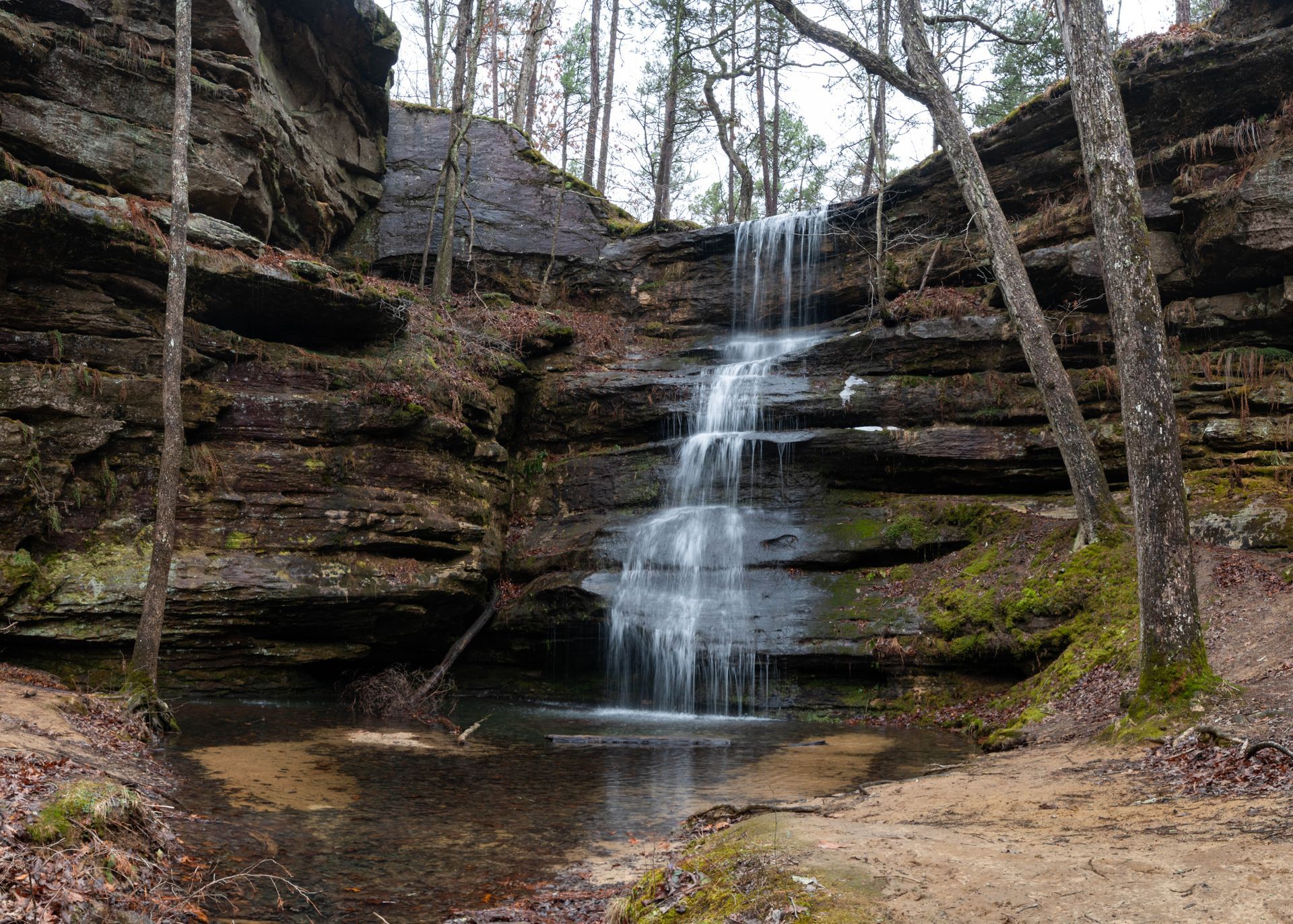
Featured above is a photo by Garrett Frandson of a waterfall at Hickory Canyon Natural Area in Missouri.
Before the 1970s, the way that the Unites States handled water pollution probably felt more like the wild west than the sophisticated checks and balances that we have today. Industry was booming from recent human technological advances, but people hadn’t advanced to cleaning up the resultant messes. Waste generated from commercial, industrial, agricultural, and residential development easily made its way into nearby streams and rivers with little in place to buffer the potential impacts. And impacts there were!
Near Cleveland, Ohio, the Cuyahoga River famously caught fire several times from high levels of industrial waste before then-mayor Carl Stokes sounded the wake-up call for the country. From fires and fish kills to sewage and salts, many rivers and lakes were suffering because people were letting pollutants float downstream without reducing the impact they were having. This contributed toward the reworking of the Federal Water Pollution Control Act of 1948 into what we now know as the Clean Water Act (CWA), first written in 1972. While there have been many additions and modifications to this piece of legislation since then, the core goal of the CWA remains to
“restore and maintain the chemical, physical, and biological integrity of the nation’s waters.”
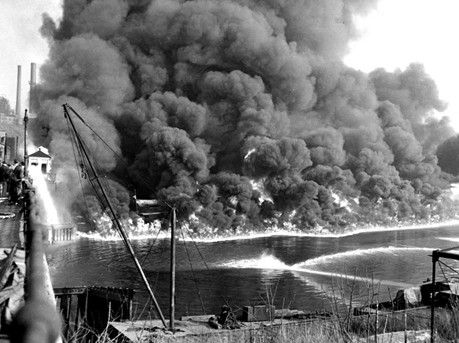
Featured above is a photo of the Cuyahoga River Fire in 1952.
The aim was to do this by 1985 and, in the meantime, to at least make waterbodies both “fishable” and “swimmable”. You can probably guess that that didn’t fully happen; however, the CWA did set up a framework for regulations for what entities were allowed to put into most streams and lakes. This greatly reduced the amount of pollution that was coming into our nation’s waters. Today, every state is mandated to regulate certain activities of entities like wastewater treatment facilities, industrial facilities, mining operations, and construction companies that go on in or around our water bodies.
The CWA mandates that states develop regulations describing what is bad for our water bodies with what are called water quality standards. These standards help to protect waterbodies for specific so-called “designated uses,” or things we want water bodies to be used for, like aquatic life, recreation, and drinking water. Entities that used to be unregulated must now obtain permits that say what they can and cannot put into our water bodies and how much of a given pollutant is allowed. The CWA gave authorities the ability to, if entities stray from their permits, enforce their permits and pursue legal action. The CWA also provides a framework for facilities to receive financial help to upgrade their facilities so that they can meet new and improving water quality standards. The CWA also provides a framework to fund the implementation of best management practices that help reduce any polluted runoff from nonpoint source areas like agriculture/pasture lands and urban areas. About 3/4 of our polluted waters in Missouri today come from these nonpoint sources.
It’s been over 50 years since the CWA was passed, and although we’ve come a long way, there are still many improvements to be made. We still have many waterbodies that need our help to be healthy again. That’s why we’re so grateful for people like you who care about our waterbodies. Every time you go on a litter pick-up, tell your friends and family about the health of your favorite waterbody, or monitor your local stream, you’re making a tangible difference in your watershed. Together, we’ll keep moving the needle toward a healthier and brighter future for our waterbodies.
Read The Latest Fact Sheet
#40 Heat Safety ADvisorY
Learn more about Outdoor Recreation in the Summer Months, in our latest Fact Sheet, provided by our wonderful partners at the Department of Health and Senior Services.
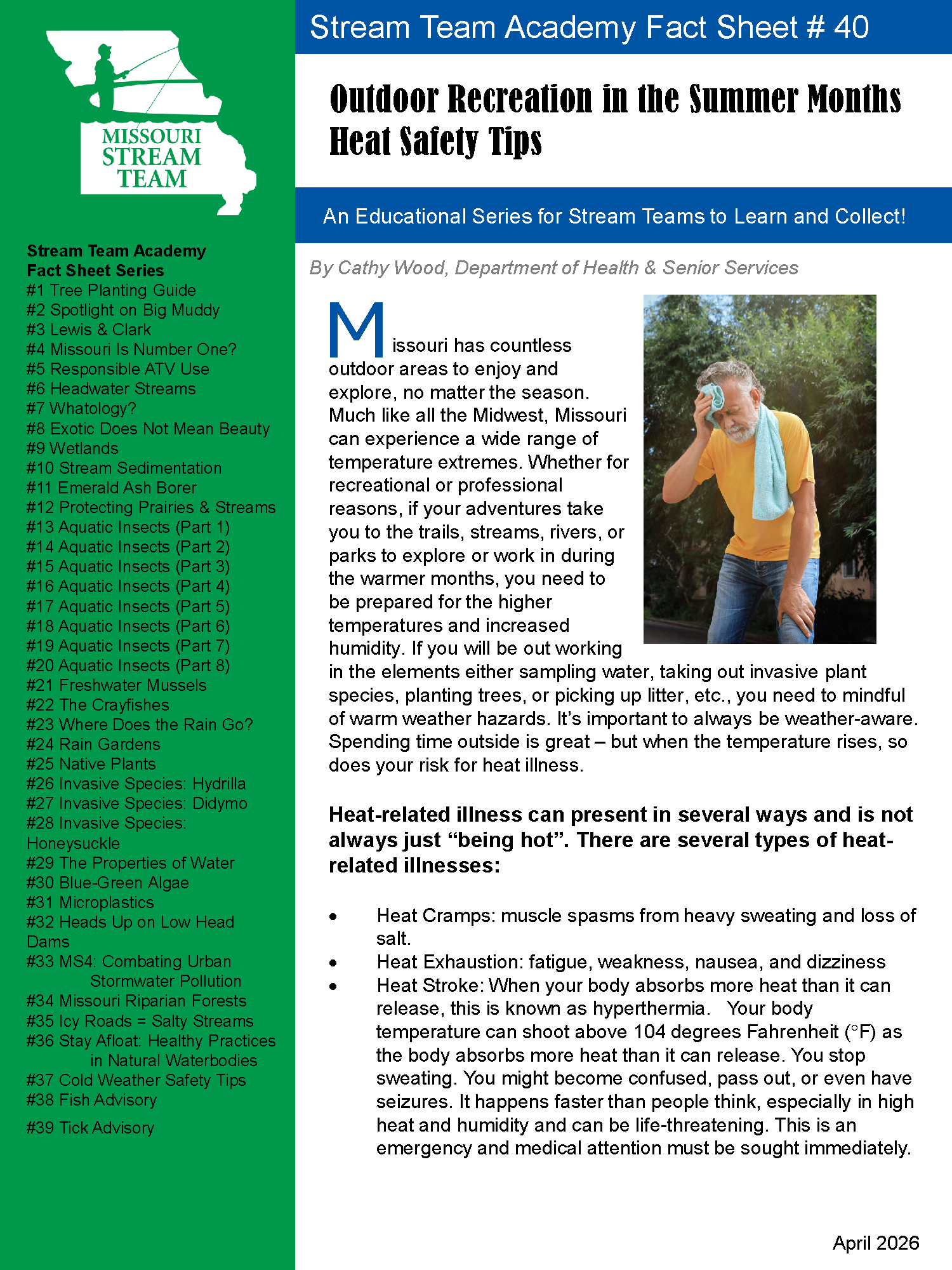
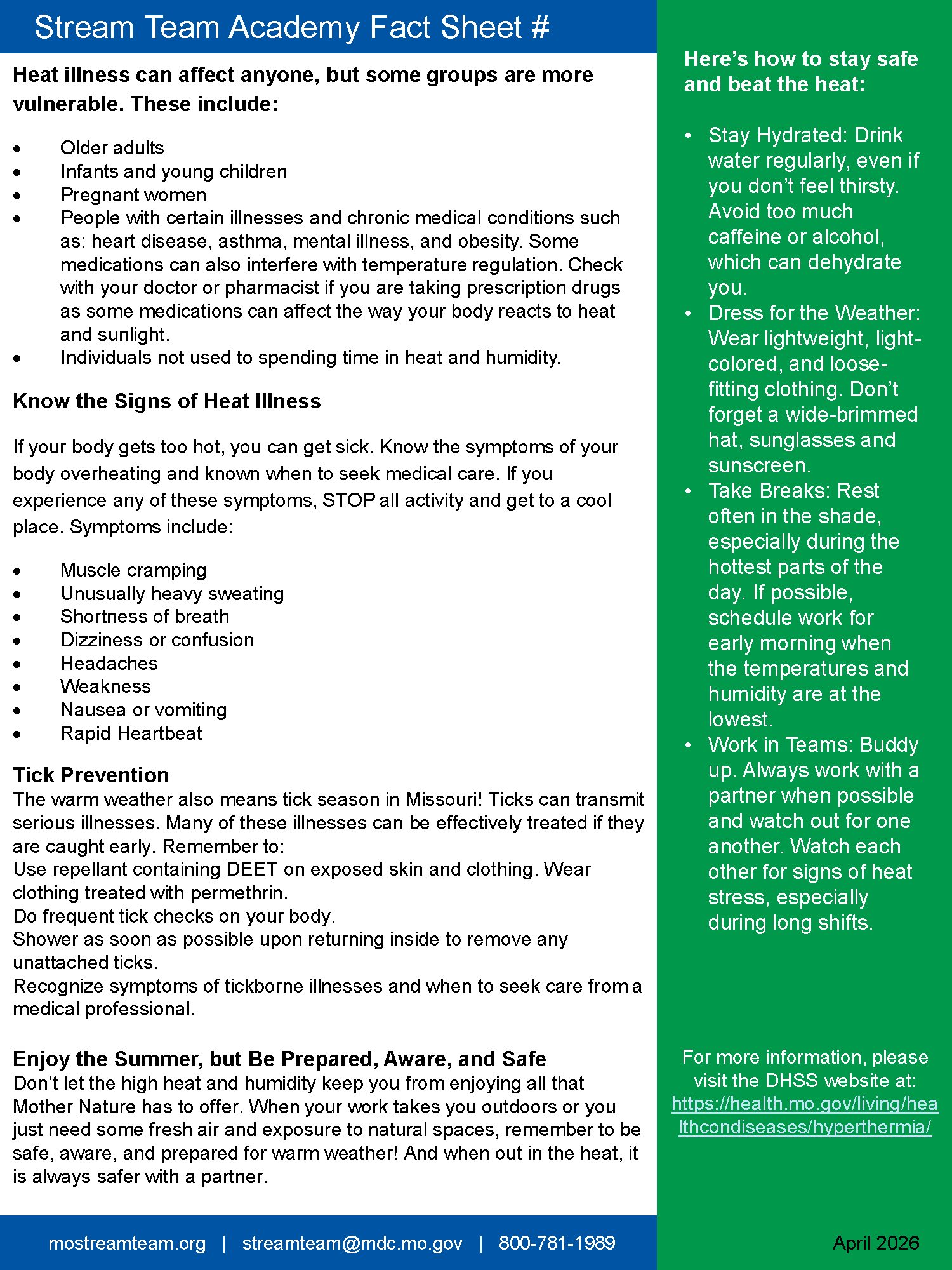
Select the image to enlarge.
Download the PDF here.
See you on the river - Farewells from Staff
Lily smith
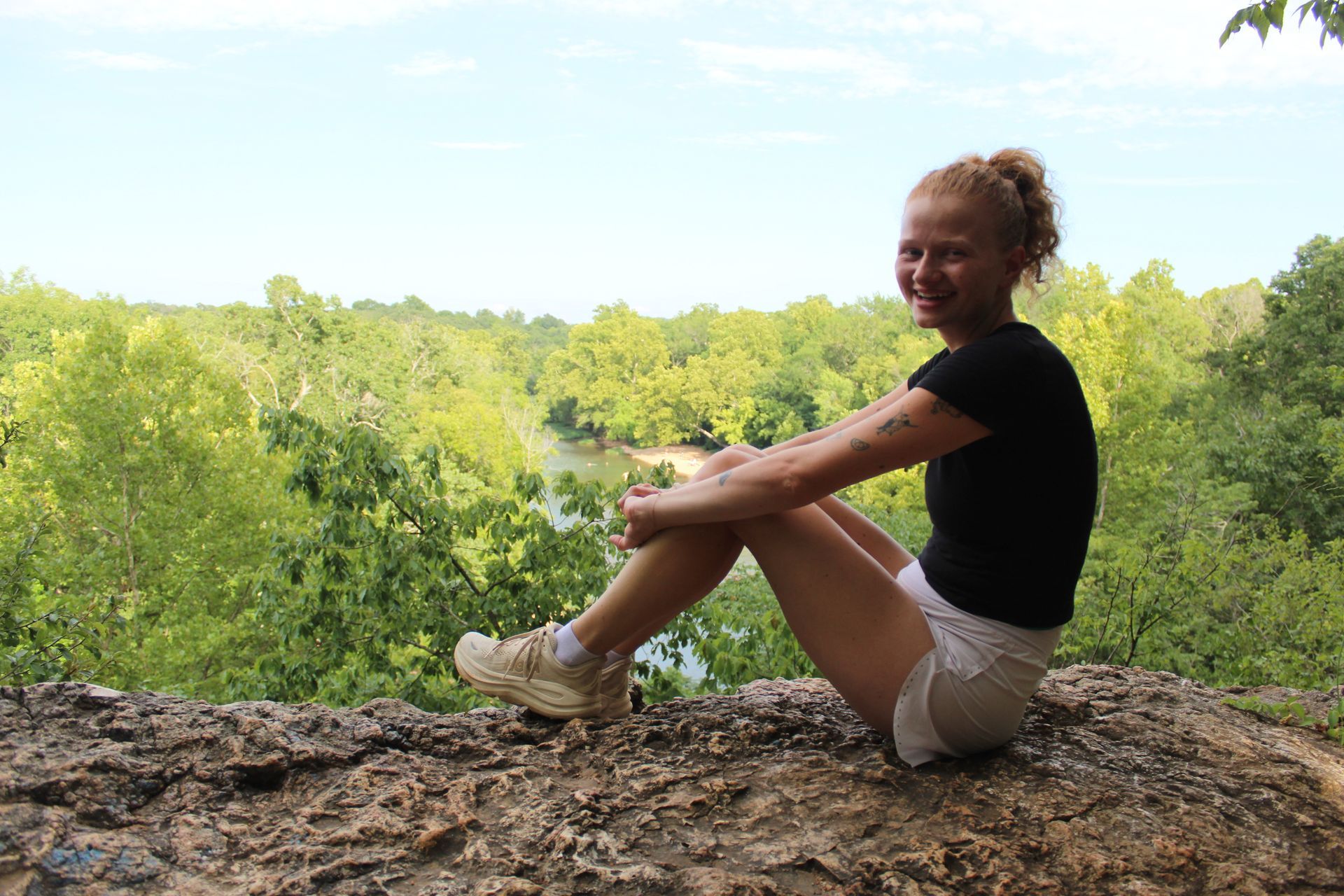
A message from Jeff Cantrell:
Building a community’s enthusiasm for our shared aquatic resources is a major component of Missouri Stream Team outreach and mission’s undertaking. Last summer, we hired Lily Smith as our newest Volunteer Engagement Assistant for the SW and Ozark Region. Lily was no stranger to the Missouri Department of Conservation Office in Joplin; she was regularly walking trails and photo-journaling along our creeks. I knew, on day one, she was an outstanding addition for our local team. Lily and I went to Hickory Creek in Neosho to prepare for a regional water festival. While we gathered macro-invertebrates, a Northern Water Snake, Nerodia sipedon, fell out of a box elder tree and splashed down in the water only a couple of feet in front of us. Her immediate response was, “It’s a good day if you see a snake!”
That first day of stream work easily led to her “can-do” efforts and customer service with the same enthusiasm and ear-to-ear smile in all work endeavors. Lily brought insight and networking to young adult circles, and I often gleaned her perspectives. She’s truly been a bright spot for my workweeks and has been such an asset tackling issues affecting our local aquatic systems (e.g., urban stream influences downstream and our increasing awareness of problems with plastic litter).
It’s sweeter than bittersweet news that’s she’s continuing her pursuit in higher education and advanced employment opportunities. I’m delighted she’s in our Missouri Stream Team circle as a valued friend and professional partner. We are sure she will continue to relay conservation ethics to our community.
- Jeff Cantrell, Volunteer Engagement Specialist
Cara Coates
A foreword from Becca O'Hearn:
We are saying farewell to Cara Coates as she begins a new chapter in her career. Since joining the Stream Team Program in 2022, Cara has been a valued member of our team, bringing enthusiasm, creativity, and a consistently positive spirit to everything she does.
Cara first joined us as a Water Quality Monitoring Assistant, where she quickly demonstrated her creativity in creating outreach content. She later transitioned into the role of Volunteer Engagement Specialist (Stream Team Coordinator), where she expanded her impact even further. In this role, she not only supported and connected with volunteers in the northern half of the state, but also led marketing and communications efforts for the program.
Many of you have experienced Cara’s energy and enthusiasm firsthand. Whether she was coordinating events, sharing program updates, or developing outreach materials, her creativity and keen eye for design helped elevate how we tell the Stream Team story. Her ability to build relationships and bring a sense of excitement to her work has left a lasting impression on both our team and our volunteers.
We are grateful for Cara’s positive impact. We wish her all the best in her next adventure, and we know she will continue to do great things.
- Rebecca O’Hearn, Volunteer Programs Manager
A message from Cara Coates:
I want to take a moment to share that I will be stepping away from my role, with my last day being April 30th.
Working with you all has been one of the most meaningful parts of my time in this position. Your commitment to Missouri’s streams, your willingness to show up for your communities, and the countless hours you’ve given to conservation truly make a difference. I have had the privilege of seeing your impact firsthand, and I am continually inspired by the passion and care you bring to your work.
Thank you for your dedication, your partnership, and the trust you have shown me in this role. It has been an honor to support you.
While I may be stepping away, I know the Missouri Stream Team will continue to thrive because of volunteers like you.
See you on the river,
- Cara Coates, Volunteer Engagement Specialist
Tabitha Gatts-Hendricks
A message from Tabitha Gatts-Hendricks:
I have accepted another position within the Department of Natural Resources, effective April 16th, 2026. I’ll be working with the 319 grant management program as the watershed coordinator. The 319 program seeks to provide funding for watershed improvements around the state. All the amazing volunteers with the Stream Team program have inspired me to continue making positive changes that help our water resources, and many of you have even been a part of 319 projects in your areas! I will not be going far and may continue to be in contact with some of you regarding these projects.
Thank you all for your dedication, love, and pursuit of healthy watersheds! Your passion has made the past 5 years both fun and memorable!
I wish you all the best as you walk, swim, paddle, fish, and monitor around our beautiful Missouri streams!
- Tabitha Gatts-Hendricks, Stream Team Volunteer Water Quality Monitoring
Build your monitoring confidence in our latest Monitoring Minute
monitoring confidence
By Pam Taylor, Citizen Science & Education Assistant
So, you’ve attended your first Water Quality Monitoring Workshop, and you are feeling overloaded. Don’t worry, here are some ideas to ease into monitoring.
Stay Close to Home
Many of our volunteers become interested in Stream Team because of the streams and creeks that are close to home. No need to go far and monitor all 110,000 miles of Missouri streams when you can start at home. If you don’t own property with a stream on it, you can always go to a nearby stream or creek located in a public park.
Visit Your Site Before Adopting
You can find a site using our interactive map, but conditions aren’t recorded there. Check it out and look for places to access the water; can you get yourself and equipment to the site safely? Be sure you have all the proper permissions to be there before you head out. While you scope the site, if you’ve determined this is the site for you, fill out the visual survey datasheet while you are already there. Remember, you’ll need to submit one visual survey in order to request monitoring equipment.
Take a Friend
It is always a good idea to take a friend whenever you are in the field. Bringing a buddy will keep you safe as well as lending a hand while monitoring. Only one trained monitor needs to be present while monitoring, so bring anyone you want! They don’t need to be a Missouri Stream Team volunteer and maybe they’ll attend a workshop in the future!
Register for a Level 2 Workshop
After you’ve been out monitoring a couple of times, you can attend a level 2 workshop to practice your skills, ask questions in the presence of instructors, and keep up to date with current methods. We recommend you attend a level 2 workshop every 3 years!
When in Doubt, Reach Out
If you ever have a question or need clarification on what to do, Missouri Stream Team staff are available to help. Send your questions to Stream.Team@mdc.mo.gov and we’ll be glad to help!
First time monitors may be overloaded with information after attending a workshop, but it doesn’t have to be scary. These are just some ways to gain confidence while monitoring and take your first steps into being a monitoring champ!
Catch up with teams around the state with the Riffle Review
Riffle Review - 7,169 Teams strong
A quarterly glimpse of Stream Team activities - in the last quarter, Missouri Stream Team volunteers reported:
- 288 Total activities
- 1,397 Total participants
- 5,488 Hours
- 69 Tons of trash collected
- 31 Water quality monitoring trips
Team Snapshots
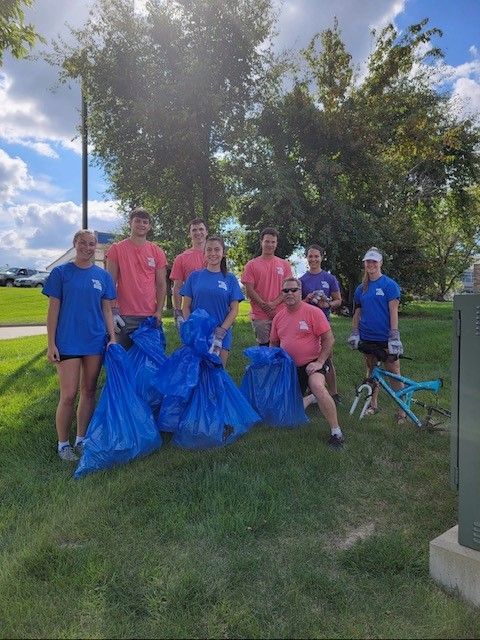
Fisheries & Aquatic Science Society (FASS) – ST#442
Over the past year FASS, a student society at Mizzou, has restarted their Missouri Stream Team. Since the society restarted, they have been involved with field sampling, microfishing, water quality monitoring, litter pickups, and are very excited about our new crayfish monitoring project launching this year.
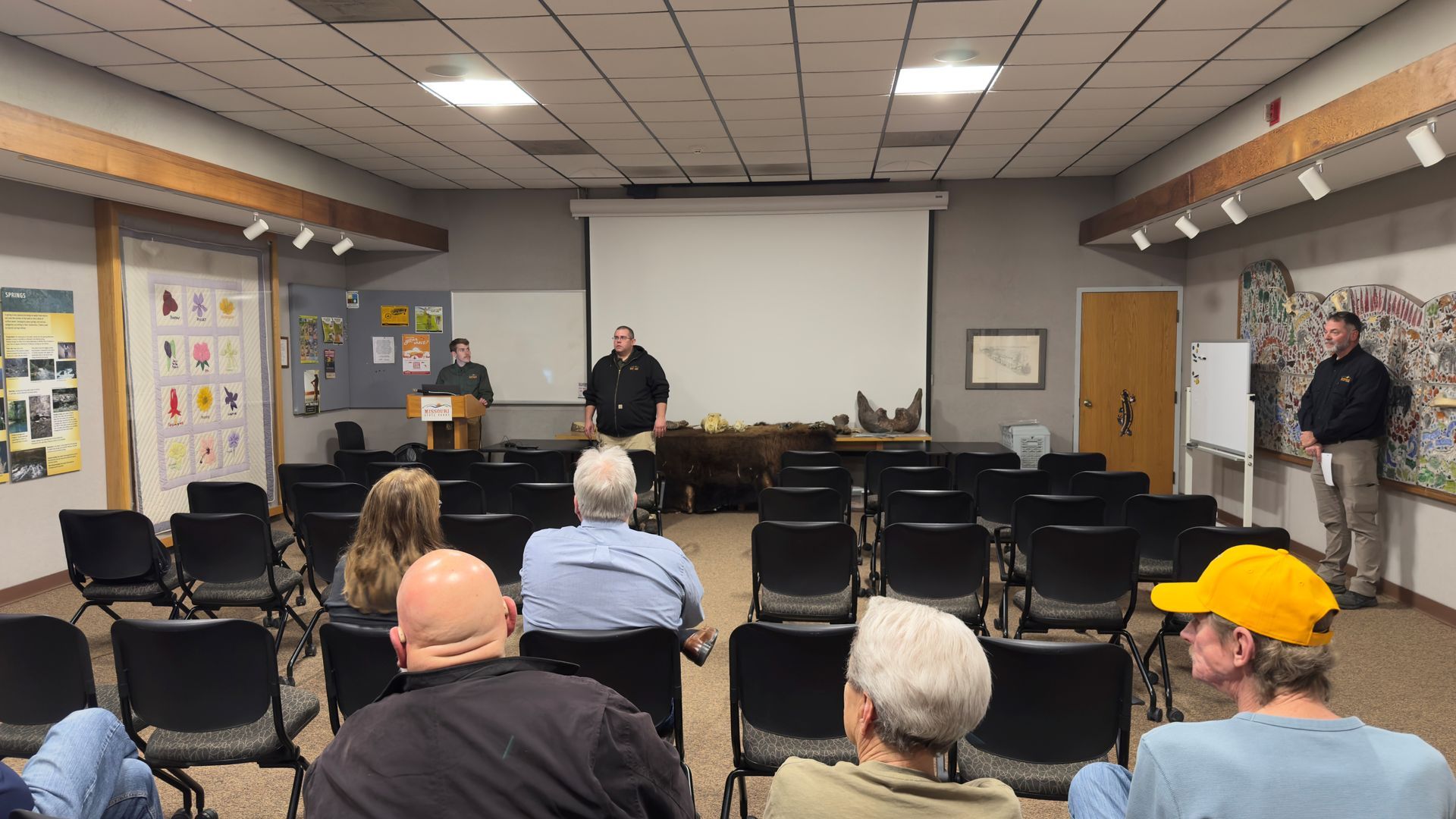
Jefferson County Stormwater – ST#2763
Michael Cook, with Stream Team 2763, continues to educate the citizens of Jefferson County on the issues, concerns, and the value of a healthy watershed. The focus of this workshop is the main stem of Rock Creek. Participating in these Jefferson County Stormwater workshop are the Missouri State Parks, USACE, MU Extension, a Jefferson County Council Member, and the MDC/Stream Team Program.
Southwest Missouri – Stream Team #5925
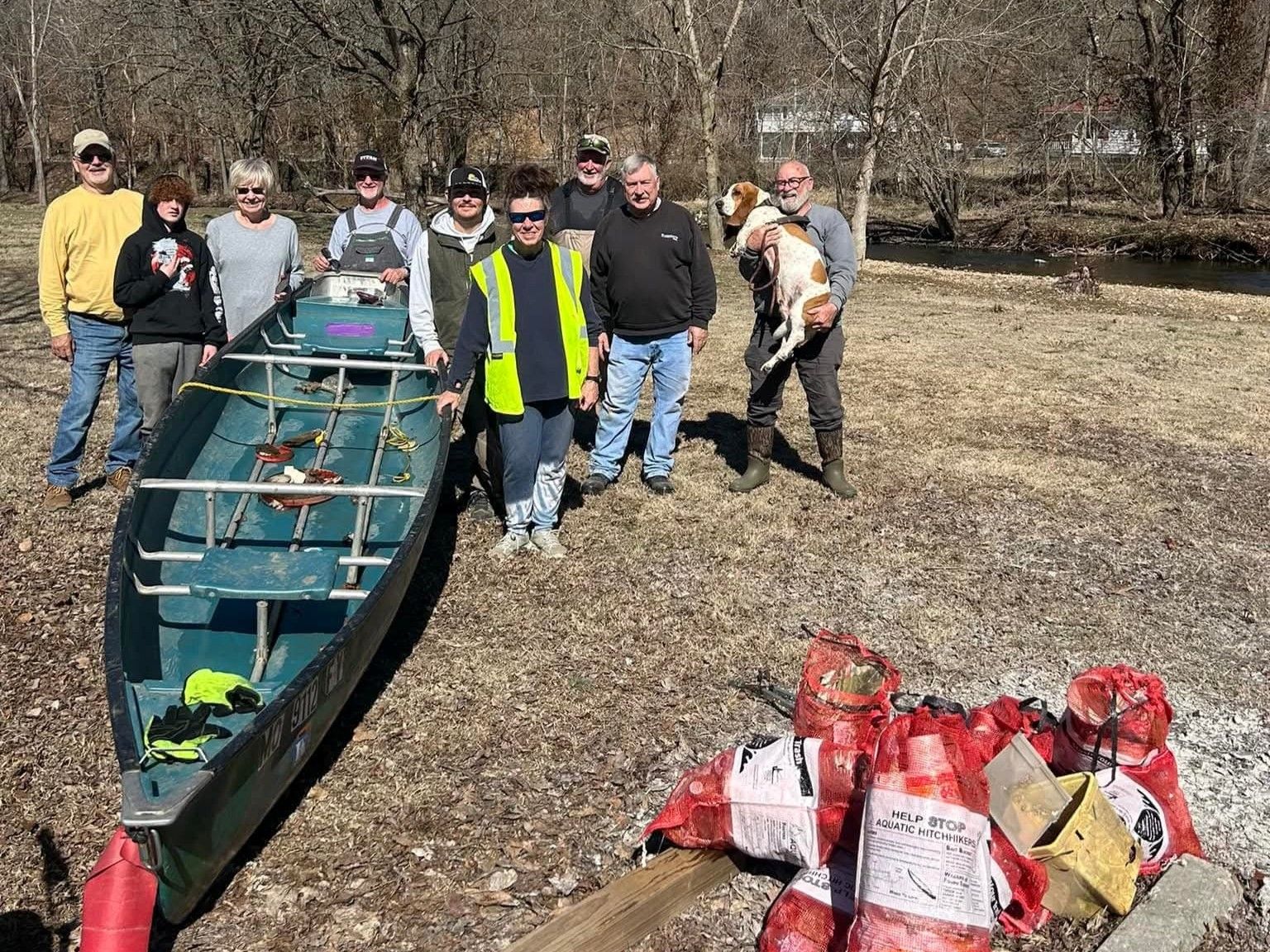
Southwest Missouri Stream Team 5925 took to Hickory Creek and Neosho’s public parks in February just prior to the official trout opening. A solid group of volunteers ranging from teens to folks in their “80 Years Young” navigated weather conditions to finally pick a suitable workday in the watershed. The area looks wonderful now, thanks to the gleaning of 43 bags of assorted items from trash to discarded clothes and a musical instrument. The name Neosho has Native American origins and refers to the land of freshwater and springs. A big Thank you goes to the whole crew of volunteers with #5925.
The 100 Club
A highlight of Teams that have contributed more than 100 hours in the last quarter -
| Team Number | Team Name | Hours |
|---|---|---|
| 1875 | Missouri River Relief | 895 |
| 4922 | The Tireless Cutters | 761 |
| 4847 | Southern Ozarks | 500 |
| 7178 | Mr. Lynn CMS | 490 |
| 5863 | Salty Scuds | 410 |
| 6834 | KC Wildlands | 144 |
| 6897 | Rockhurst University | 143 |
| 1365 | James River Basin Partnership | 143 |
| 7117 | CBOLC 07-25 | 110 |
| 6800 | Missouri Conservation Corps | 108 |
Get Excited about Activity Prizes
Quarterly Activity Prize Drawing - Prizes for Last Quarter
Quarter Prizes:
- Moultrie Solar Cellular Trail Camera
- BLACKSTONE Smash Burger Kit
- Stainless Steel Insulated Food Jar
Quarter Youth Prize:
- Dynamic Discs, Disc Golf Set
Quarterly Activity Prize Drawing -Prizes for NEXT Quarter
Quarter Prizes:
- BLACKSTONE Ultimate Griddle Kit
- Quick Fill Electric Pump
- 3D Air Mesh Harness and Angler’s CHEST PACK
Quarter Youth Prize:
- Robert Bateman Great Blue Heron Puzzle
Fill out an Activity Report for your past or upcoming events, and you could win a prize next quarter!
If you ordered supplies in advance, please don’t forget to report your accomplishments after your event. Missouri Stream Team relies on your reporting to continue to get funding!
Read the Latest Coalition Corner
Coalition corner
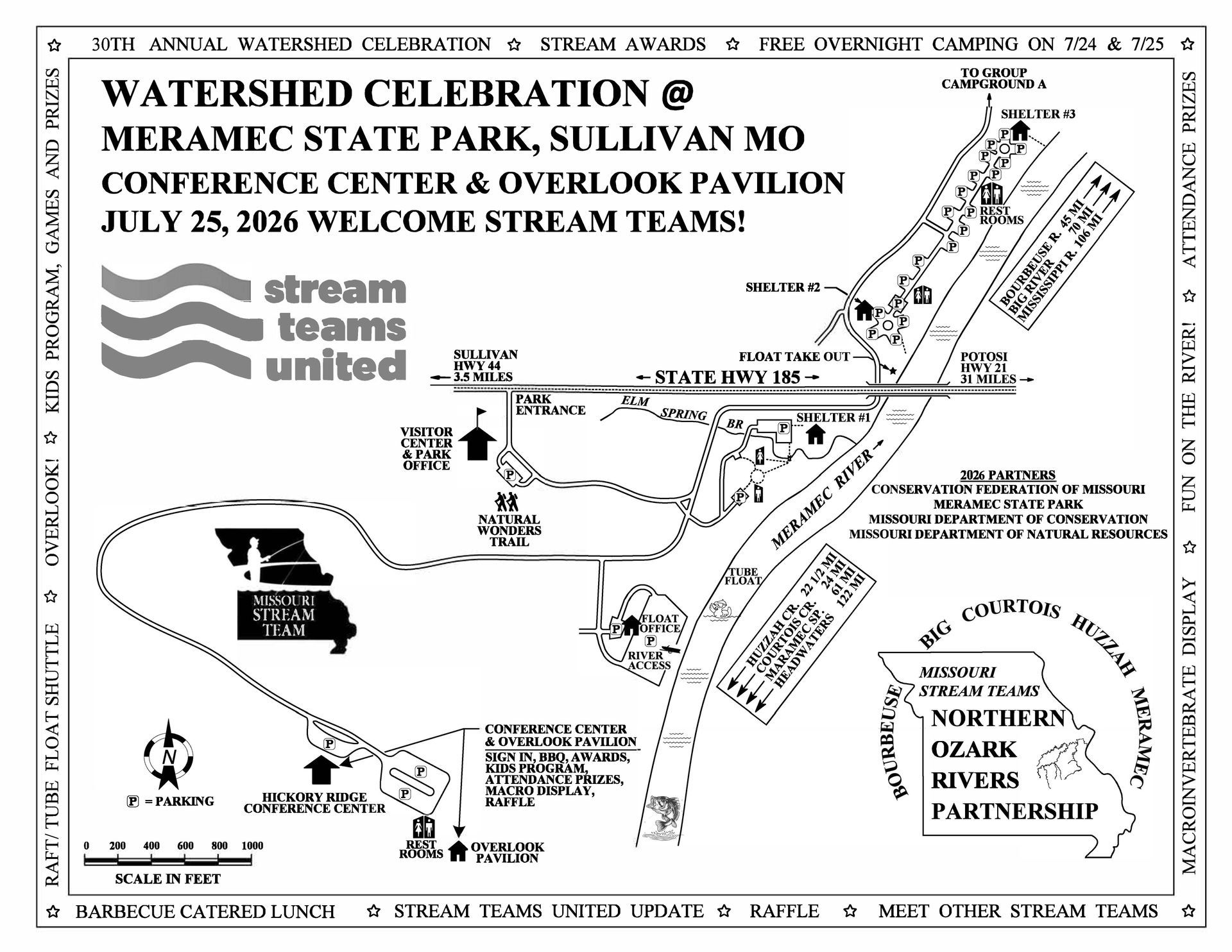
Celebrate with us on July 25th at meramec State park
By Mary Culler, Executive Director of Stream Teams United
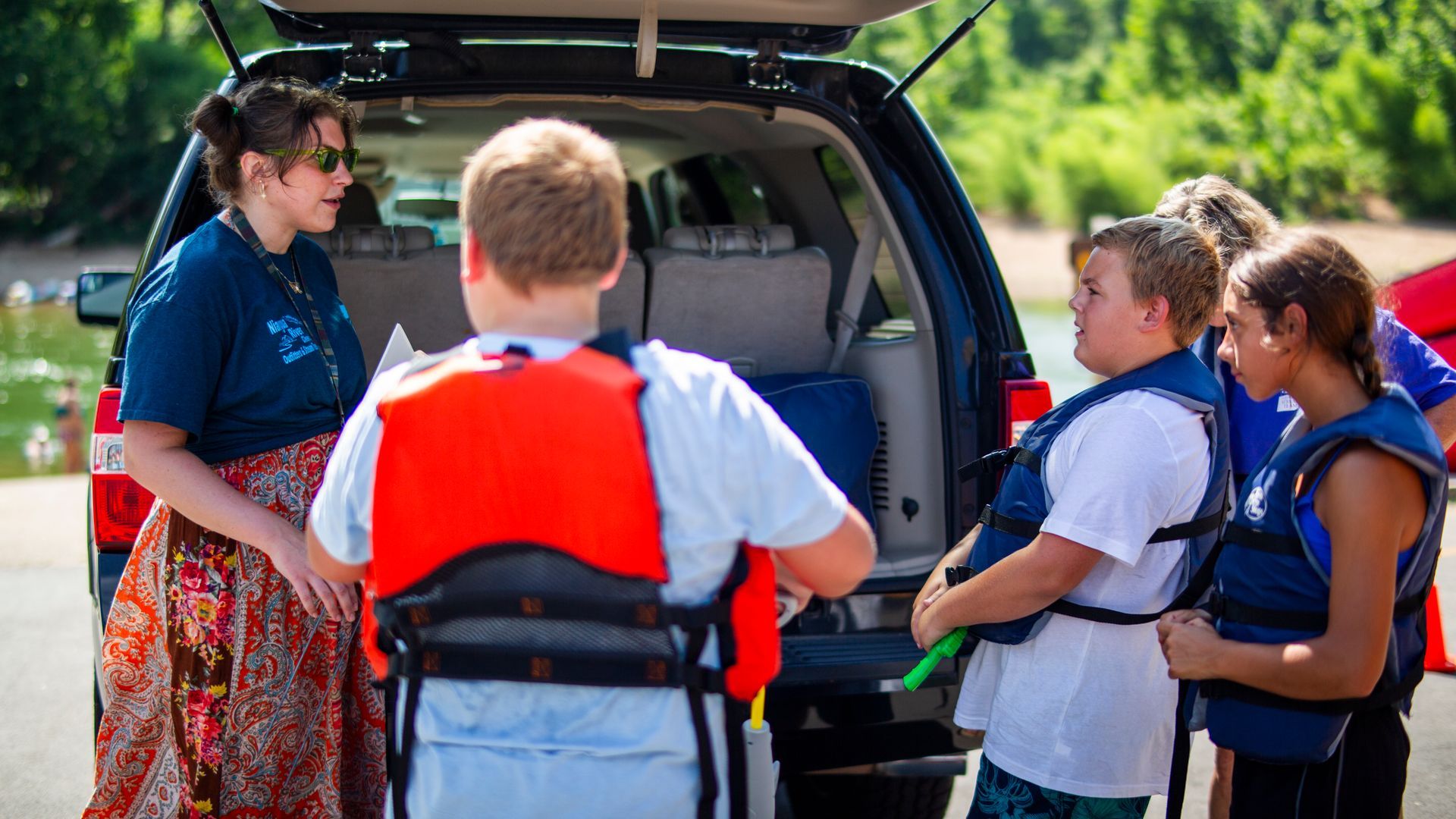
Featured above is a photo of Ashley Packwood talking to young volunteers at the 2025 Watershed Celebration.
This year’s Watershed Celebration at Meramec State Park on Saturday, July 25th, will be the 30th year for this annual gathering of Missouri Stream Teams. All Missouri Stream Teams are invited to join us, and there is travel assistance available for Stream Team volunteers. In 1997, Missouri Stream Team volunteers of the Northern Ozarks Rivers Partnership Stream Team Association, who clean up streams of the Meramec River watershed, gathered with their families and friends for the first time as a celebration of the Meramec River Watershed. The site for the celebration, at Meramec State Park, is significant, as the conference center at the park is near the site of a proposed dam, that would have impounded the free-flowing Meramec River.
In the early 1970’s, a federal project was proposed to dam the Meramec River. The plan proposed to inundate approximately 23,000 acres of land with the new reservoir. The dam for the reservoir would have been near present day Meramec State Park. River advocates and elected officials rallied to save the Meramec as a free-flowing river. In 1978, a public referendum rejected the project and halted the construction of the dam. Voters residing within the 12 counties of the Meramec River basin and St. Louis decided on August 8, 1978 — 64% of the voters said no to the Meramec Dam. The saving of the free-flowing Meramec River, and its globally significant biodiversity, is one of the greatest river conservation stories for the state of Missouri.
This year’s celebration is an opportunity to meet Missouri Stream Teams and staff from around the state, gather for a day of family friendly activities, share a meal with a provided lunch, and recognize the individuals who are recipients of annual Stream Team awards. We will have kid games, demonstrations, and tubes and a shuttle for tubing on the river! Complimentary tent camping is available at Group Site A for Missouri Stream Teams on Friday, July 24th and Saturday July 25th. Stream Teams United has travel assistance available for Missouri Stream Team volunteers, through the generous support of the Missouri Department of Conservation. Fill out this form by July 5th to receive travel assistance. We hope to see you there! Find out more at: https://www.streamteamsunited.org/watershed-celebration-picnic.htmlr their local waters!
-Mary Culler, Executive Director, Stream Team United